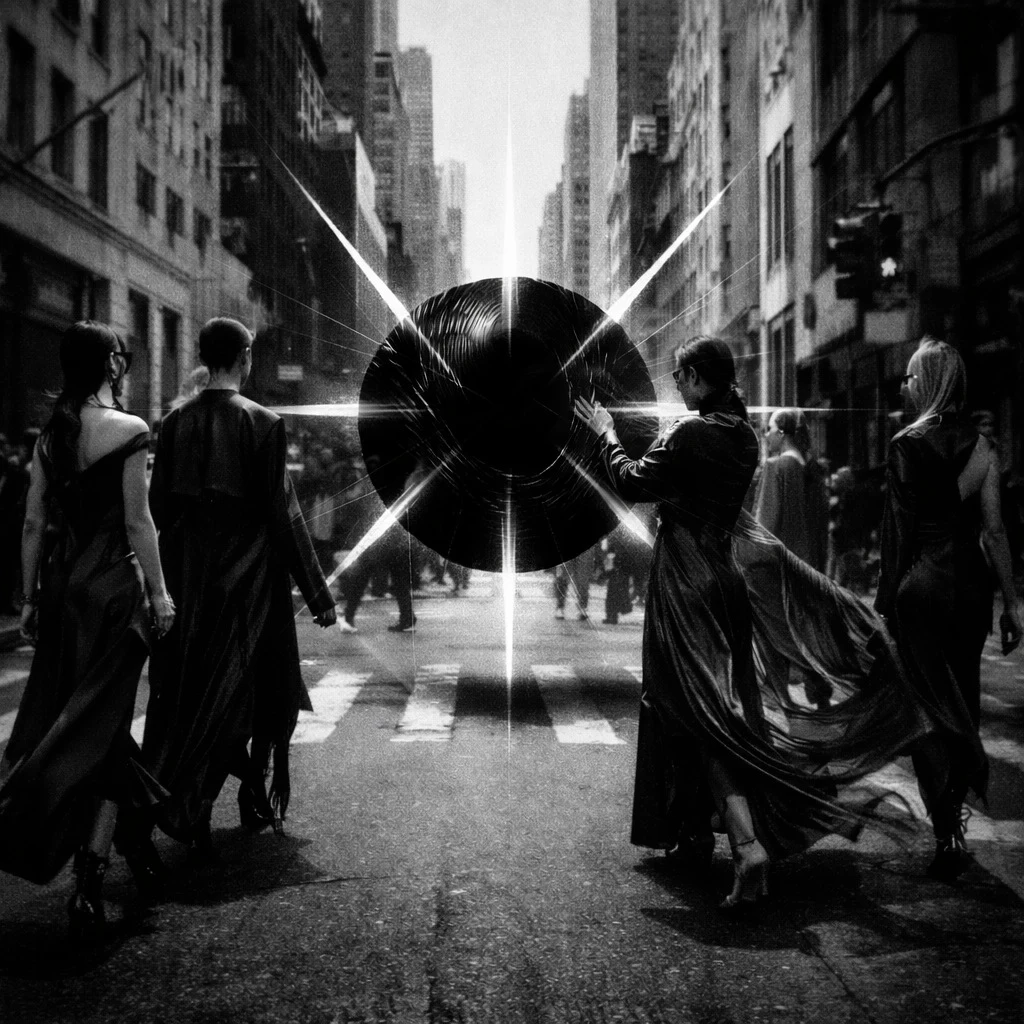
A system is most honest at the boundary where belief becomes behavior.
The original BTM closed by moving from cypherpunk architecture back into magical language. The transition belongs here: protocols and rituals both define actors, states, permissions, transitions, failures, and a declared end condition.
That resemblance does not prove the supernatural. It does explain why operators reach for symbolic language when ordinary documentation cannot hold the emotional weight of a transformation.
FOUR WORDS AT THE EDGE OF THE SYSTEM
BERAMYTHAS
A working or personal formula in the BTM draft. We found no reliable basis for calling it a standard word from Crowley's Book of the Law; preserve it as the author's own signal unless provenance is supplied.
ABRAHADABRA
A central Thelemic formula used by Aleister Crowley, often associated with completion of the Great Work. Its eleven-letter construction is part of its symbolic treatment.
CHORONZON
A figure associated in Thelemic writing with the Abyss, dispersion, and ordeal. Choronzon is not the Holy Guardian Angel; those ideas occupy different roles in the system.
KIA
In Austin Osman Spare's vocabulary, Kia points toward an unconditioned self or universal consciousness. BTM uses 'IO KIA' as a closing acclamation: manifest chaos; the operation is done.
THREAT MODEL BEFORE TOOL
01 // ASSET — What are you protecting?
02 // ACTOR — From whom?
03 // CAPABILITY — What can they actually do?
04 // IMPACT — What does failure cost?
05 // MAINTENANCE — What can you sustain?
06 // RECOVERY — How do you come back?
A PROTECTION YOU CANNOT MAINTAIN BECOMES THEATER.
FIVE LAYERS OF PRIVACY
| LAYER | PRACTICE |
|---|---|
| DEVICE | Use a passcode, automatic updates, encrypted storage, short lock timeout, and tested backups. Lost hardware is a common threat model. |
| IDENTITY | Use unique passwords, a password manager, multi-factor authentication, and separate public, personal, and recovery identities where practical. |
| TRANSPORT | Prefer encrypted services. Understand what a VPN, Tor, DNS settings, and private relays can and cannot hide. Transport privacy does not erase account identity. |
| CONTENT | Minimize unnecessary collection. Encrypt sensitive files. Share the smallest useful amount. Metadata can remain revealing even when content is encrypted. |
| RECOVERY | Keep offline recovery codes, a second factor, tested backups, and instructions for trusted people. Security that locks out its owner has failed. |
Privacy is a practice, not a product SKU.
THE KERNEL-SHADOW SHELF
| TITLE | AUTHOR / EDITOR | DOOR |
|---|---|---|
| The Art of Intrusion | Kevin D. Mitnick and William L. Simon | Real stories from the perimeter-collapse era: human assumptions, workflow gaps, and corporate blind spots. |
| The Art of Invisibility | Kevin Mitnick with Robert Vamosi | A privacy field guide to metadata trails, identity exposure, and everyday discipline. |
| The Art of Deception | Kevin D. Mitnick and William L. Simon | The human element: trust, authority, urgency, and error before the firewall. |
| Necronomicon | H. P. Lovecraft; edited by Stephen Jones | Forbidden texts, impossible geometries, and knowledge as a door. |
| The Rootkit Arsenal | Bill Blunden | Operating-system internals, concealment, and the defensive lesson that unseen code can still own a machine. |
FIAT JUDGE: IN CODE WE TRUST
Fiat Judge grew from the memory of early hacker rooms where aliases, masks, and deliberate anonymity were not only theater. They were armor, privacy, and survival.
The piece joins that older instinct with Bitcoin's Merkle tree: branches, proofs, hashes, roots, judgment, and trust. The mask watches from the ledger. Bitcoin-orange eyes and block-code textures turn the face into a false-positive camouflage pattern.
Stay hidden. Stay sharp. Let the code speak before the name does.
MASK != IDENTITY
PROOF != PERSON
LEDGER != MEMORY