A zine, a mailing list, a protocol—and the politics hiding in the architecture.
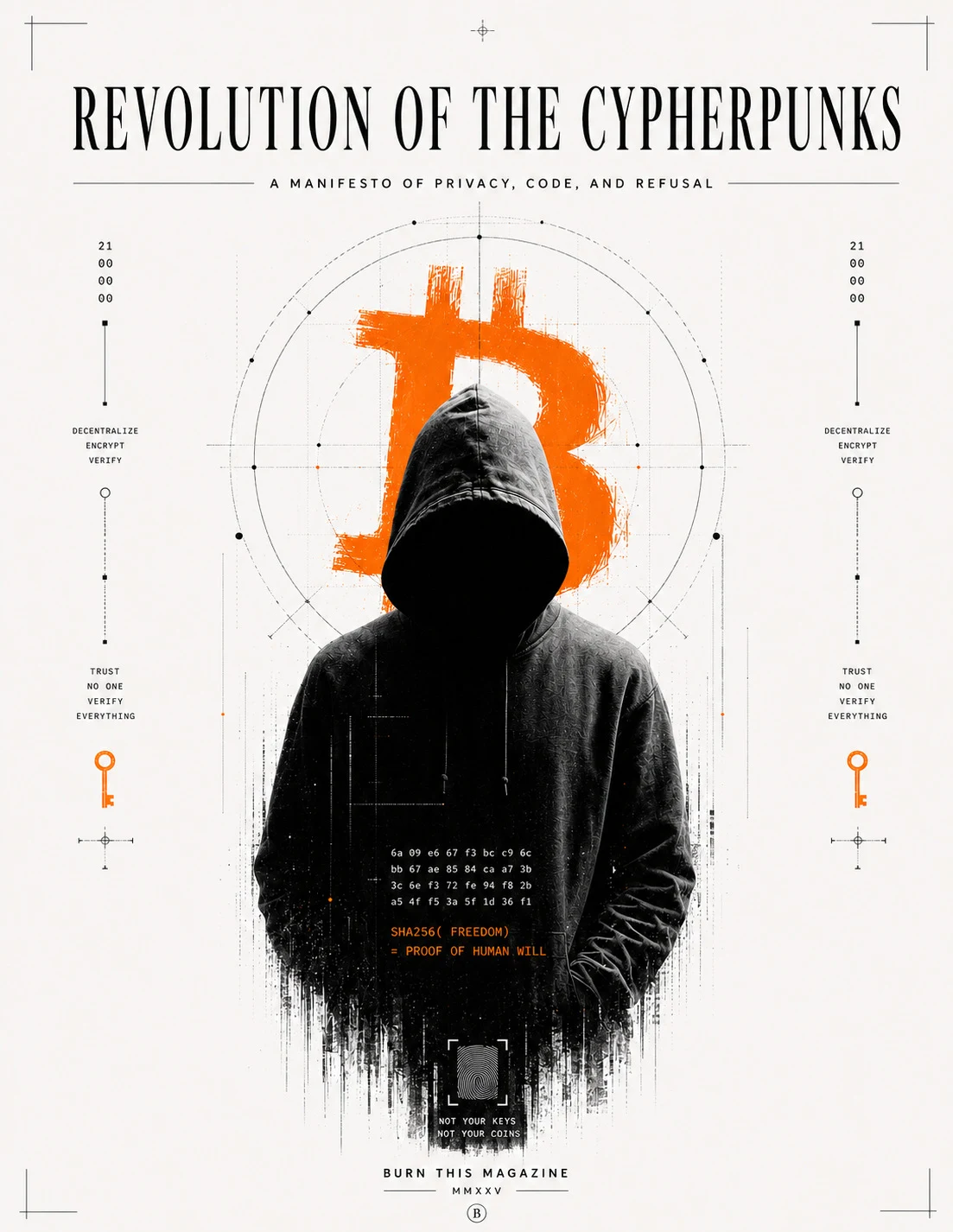
A MESSAGE IN A HOSTILE NETWORK
Before Bitcoin became an asset class, exchange ticker, political symbol, or institutional product, it was a message dropped into a hostile network.
On October 31, 2008, Satoshi Nakamoto posted to the Cryptography Mailing List with the subject 'Bitcoin P2P e-cash paper.' The opening was brutally minimal: a new electronic cash system, fully peer-to-peer, with no trusted third party.
That sentence is the detonation. Bitcoin did not arrive like a startup. It arrived like a photocopied communique: no launch party, founder video, or brand deck. A PDF, a protocol, and a proposition - what if money could move without asking a central bookkeeper?
The paper's technical core attacked digital double-spending with a peer-to-peer timestamp network and hash-based proof-of-work. Transaction history becomes expensive to rewrite, while nodes may leave and rejoin by accepting the chain representing the most accumulated work.
THE CYPHERPUNK INHERITANCE
THE LINEAGE IS OLDER
Bitcoin inherited distrust of central authorities, an obsession with privacy, and the cypherpunk commandment to publish the method rather than merely the opinion.
Timothy C. May's Crypto Anarchist Manifesto dates to 1988 and was posted to the Cypherpunks list in 1992. It predicted anonymous communication, electronic contracts, reputation systems, and markets difficult for states to supervise. May also understood the danger: the same systems that protect dissidents can protect predation.
Eric Hughes answered in 1993 with A Cypherpunk's Manifesto. Privacy, he argued, is the power to reveal oneself selectively. Anonymous systems, encryption, digital signatures, remailers, and electronic money were not requests for institutional kindness. They were things to build.
Cypherpunks write code.
REVOLUTIONARY MANIFESTO // I
They told us trust was safety. They built temples out of banks. They dressed permission as protection. They called surveillance convenience. They called dependency order.
But the wire remembered another future: a future written in keys; signed, not begged for; verified by math; a future no clerk could deny.
The cypherpunks did not wait for reform. They did not petition the gatekeepers. They built exits in plain sight. They wrote code like contraband scripture. They turned privacy into architecture.
EVERY KEYPAIR    A REFUSAL
EVERY SIGNATURE  A BORDER
EVERY HASH       A WITNESS
EVERY BLOCK      A SCAR IN TIME
EVERY NODE       A QUIET ACT OF DISOBEDIENCE
Bitcoin was not born from greed. It was born from suspicion, from frozen accounts, from the memory that access can be revoked by whoever owns the ledger.
REVOLUTIONARY MANIFESTO // II
It answered a simple insult: that free people must ask permission to move value; that money must kneel before institutions; that trust must be rented from those who profit by breaking it; that the future belongs to whoever owns the ledger.
So the ledger was made public. The mint was made mechanical. The rules were made visible. The gate was removed. The network was set loose.
No king. No banker. No rescue priest. No corporate confession booth. No master key under glass.
ONLY PROOF.
ONLY CUSTODY.
ONLY SIGNAL.
That does not make the technology morally clean. Censorship resistance can preserve forbidden truth or durable poison. Pseudonymity is not invisibility. Custody creates responsibility. Power transferred into protocols still arrives with consequences.

THE UNDERGROUND WAS ALREADY THERE
Hal Finney's own account ties the visible artifact to the underground: early PGP work, the first cryptographically based anonymous remailer, Cypherpunks participation, and then the skeptical 2008 Bitcoin announcement.
Satoshi replied to a political objection in November 2008 that cryptography could not solve political problems entirely, but might win a major battle and create a new territory of freedom for several years.
Price is graffiti on the wall after the architectural event.